Mobile and Connectivity
Verizon Speed Test vs Real YouTube 4K: Understanding Buffering
Discover why synthetic speed tests differ from real-world YouTube 4K streaming, focusing on server topology, CDN operations, and why Mbps alone do not predict buffering.
- Updated
- 2023-10-15
- Reading time
- 12 minutes
TL;DR
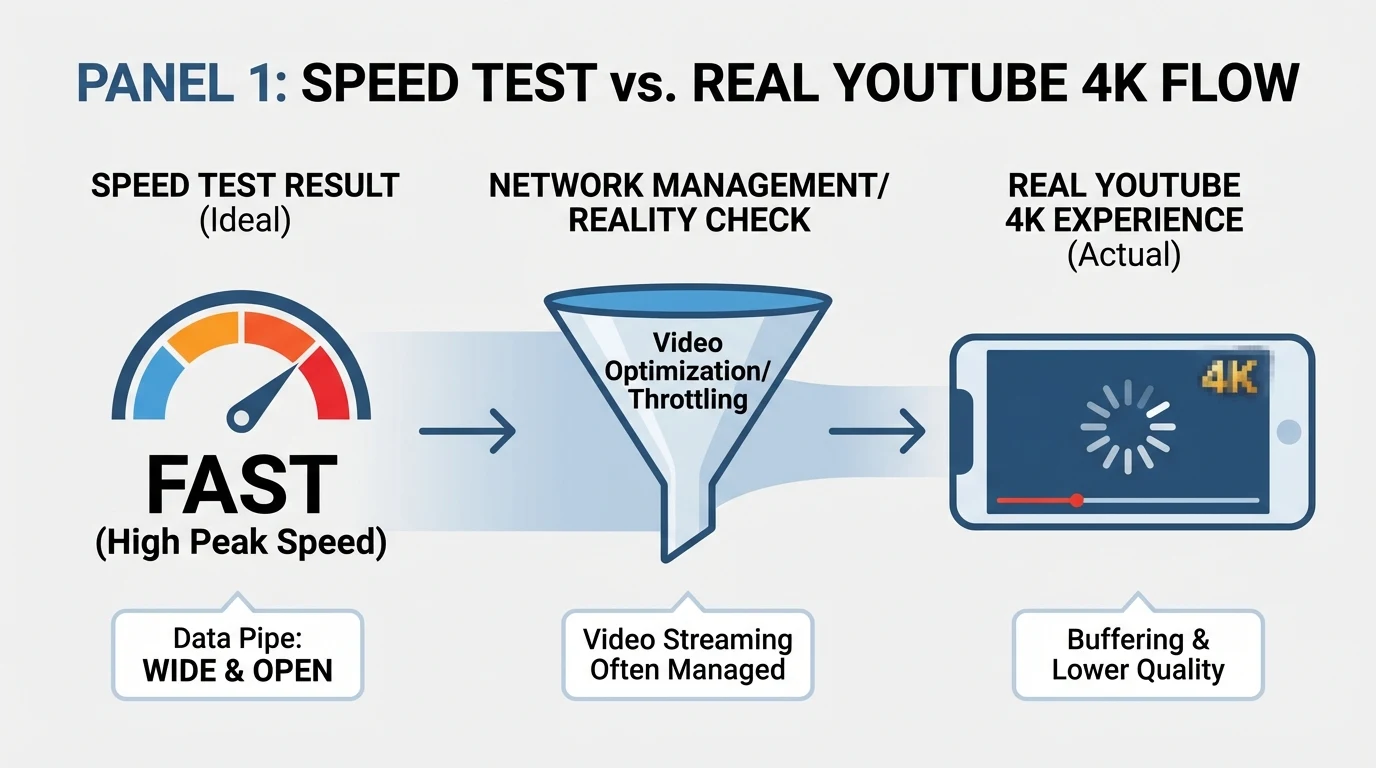
Synthetic speed tests measure theoretical maximum throughput but do not reliably predict real-world video streaming performance due to differences in server topology and CDN operations.
- Speed tests measure peak throughput under controlled conditions, not real-world streaming.
- YouTube 4K performance depends on CDN paths and peering, not just Mbps.
- Latency, jitter, and ISP policies affect streaming more than speed test results.
How Synthetic Speed Tests Work
Synthetic speed tests, like those provided by Ookla Speedtest, operate by saturating a user's connection to measure maximum throughput. These tests use a dedicated network of servers to minimize latency and bottlenecks, selecting the nearest server based on ping latency. The test involves multiple TCP connections to download and upload data, with results weighted towards download speed, upload speed, and latency.
Why Speed Tests Differ from YouTube 4K Streaming
Server Topology and Peering
The critical difference between speed tests and YouTube streaming lies in the origin of the data. Speedtest servers are optimized for minimal latency and direct peering with ISPs, while YouTube content is distributed via Google's CDN, which operates under different peering agreements and routing policies. This means that even with high speed test results, YouTube streaming can suffer from buffering due to these network path differences.
Mbps Does Not Predict Buffering
Several factors contribute to why Mbps alone does not predict buffering:
- Latency and Jitter: Speed tests give less weight to latency, but consistent, low-latency delivery is crucial for streaming.
- Adaptive Bitrate Encoding: YouTube adjusts video quality based on network conditions, which may not align with speed test results.
- ISP Throttling and QoS Policies: ISPs may apply traffic shaping to streaming traffic, affecting performance.
- Device and CDN Performance: Speed tests do not account for device limitations or CDN server load during streaming.
FCC Guidance on Speed Test Accuracy
Currently, there is a gap in FCC guidance regarding the accuracy of speed tests in predicting real-world streaming performance. This gap highlights the need for consumers to verify speed claims through multiple sources, such as the FCC Broadband Data.
YouTube 4K Streaming Requirements
YouTube's 4K streaming requires a sustained download speed of at least 20 Mbps for buffer-free playback. This requirement accounts for variable bitrates and adaptive streaming technologies. However, speed tests often overestimate real-world performance due to differences in CDN and peering arrangements.
| Source | Recommended Sustained Download (4K) | Notes |
|---|---|---|
| HighSpeedInternet.com | 20 Mbps | Higher speeds recommended for smoother buffering. |
| ACT Corp Blog | 20 Mbps or more | Consistent 4K playback requires this minimum. |
| Inorain Blog | 20-25 Mbps | Seamless experience with 25 Mbps minimum. |
Role of CDNs in Video Streaming
CDNs play a crucial role in reducing latency and buffering by caching content near users. YouTube leverages Google's CDN infrastructure to deliver content efficiently, but performance can vary based on carrier peering arrangements. This is why speed tests, which measure throughput to nearby servers, may not accurately reflect YouTube's real-world performance.
Peering and Transit Differences
Network peering involves direct traffic exchange between ISPs and CDNs, minimizing transit costs and latency. However, poor peering arrangements can lead to congestion and buffering during streaming, even if speed tests show high Mbps. Verizon users, for example, may experience buffering due to suboptimal peering with YouTube's CDN, despite high speed test results.
For more insights on optimizing your streaming experience, check out our guide on improving mobile connectivity and learn about eSIM benefits.
Disclaimer
This article is intended for informational purposes only. For specific pricing and service details, please verify with the relevant carrier or service provider.
Visual summary
FAQ
Short answers; details are in the article above.
- Speed tests measure peak throughput to optimized servers, while YouTube relies on CDN paths that may be congested or poorly peered.
- Consider using a VPN to reroute traffic through better-peered servers or verify your ISP's peering arrangements with YouTube's CDN.