Safety & hardware
Google Fi Satellite SOS: Why 'Clear Sky' Is Not Always Enough
Explore the limitations of Google Fi's Satellite SOS feature on Pixel 9 series devices, focusing on the necessity of unobstructed line-of-sight to satellites and the challenges posed by indoor and obstructed environments.
- Updated
- 2023-10-10
- Reading time
- 8 min
TL;DR
Google Fi's Satellite SOS requires more than just a clear sky; it demands an unobstructed line-of-sight to satellites, often failing indoors or near obstructions.
- Satellite SOS on Pixel 9 requires direct line-of-sight to satellites.
- Indoor and obstructed environments hinder satellite connectivity.
- Google Fi's Satellite SOS is a device-level feature, not tied to specific plans.
Understanding Satellite SOS and "Clear Sky" Requirements
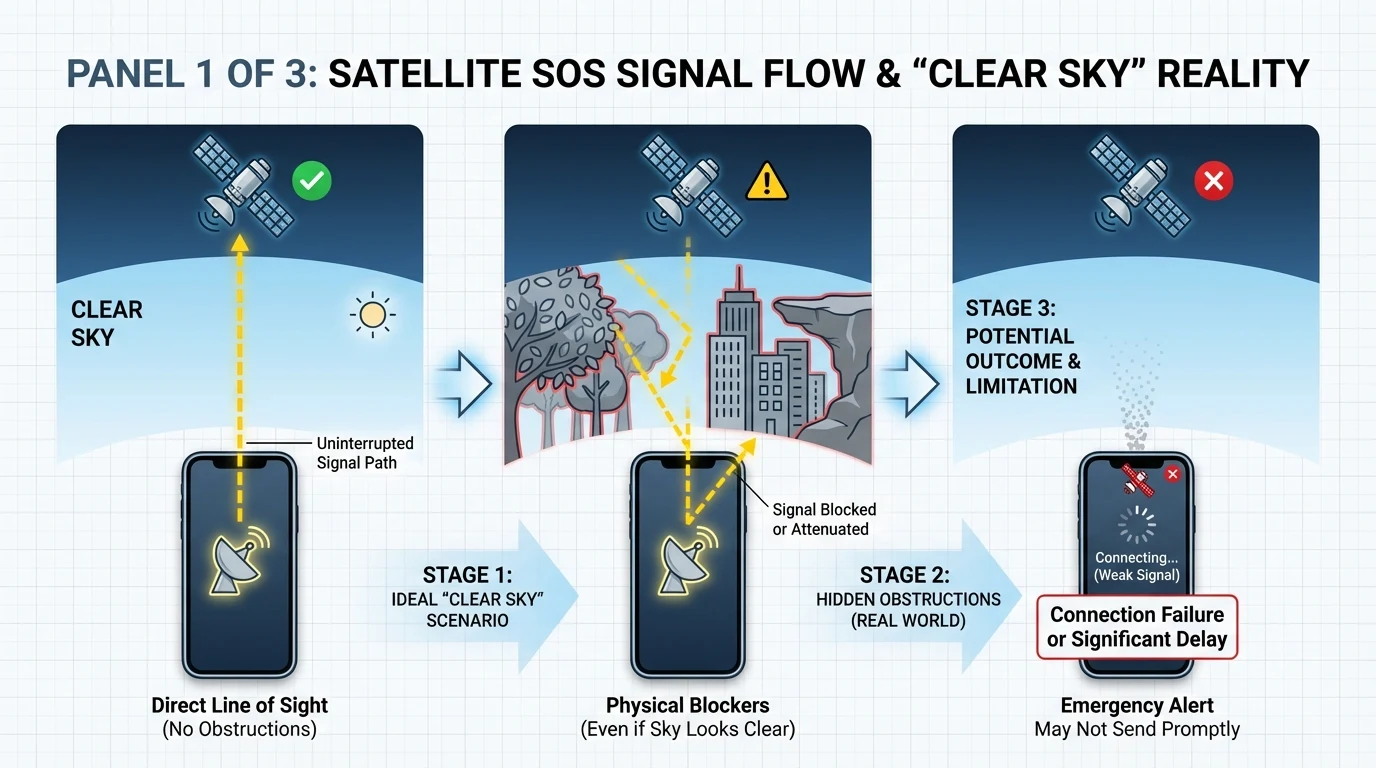
Google Fi's Satellite SOS, available on the Pixel 9 series, leverages the Exynos Modem 5400 to connect to low-Earth orbit satellites. This feature is designed to provide emergency connectivity when traditional cellular and Wi-Fi networks are unavailable. However, the term "clear sky" can be misleading, as the feature requires a direct line-of-sight to satellites, which is often not achievable indoors or near obstructions like trees or buildings.
Why "Clear Sky" Is Insufficient
Satellite signals require the phone to be visible from the sky in multiple directions. This means that even if the sky appears clear, being indoors or near a window may not suffice. The device may prompt users to reposition if the signal is obstructed. This limitation is due to the narrow beam nature of satellite signals, which are easily blocked by physical barriers.
For more on how this feature integrates with Google Fi plans, see our guide on Google Fi Plans and Features.
Official Carrier Disclosures on Data Thresholds
Google Fi's carrier pages outline monthly fast data limits for various plans, with throttling applied after these limits are reached. However, these thresholds do not explicitly address satellite data usage, which is likely minimal and focused on emergency texts and calls.
| Plan | Fast Data Limit | High-Speed Hotspot Limit | Notes |
|---|---|---|---|
| Flexible | 15 GB | Counts toward monthly data | [2] |
| Unlimited Essentials | 30 GB | No hotspot support | [2] |
| Unlimited Standard | 50 GB | 25 GB | [2] |
| Unlimited Premium | 100 GB | 50 GB | [2] |
For more details on data usage and plan specifics, refer to our article on Google Fi Data Plans.
Disclaimers and Limitations in Plan Terms
The Google Fi Terms of Service include broad disclaimers regarding service quality, but do not specifically address satellite performance. Emergency services may fail indoors or without a GPS/satellite lock, and there are no guarantees against service interruptions or inaccurate locations.
Coverage and Band Considerations
Satellite SOS relies on specific 3GPP NTN bands, such as n255/n256, which are optimized for satellite connectivity. These bands penetrate foliage and atmospheric conditions better than higher frequency bands but still require a clear line-of-sight.
Which Bands Matter Locally?
The Pixel 9's Satellite SOS uses L-band frequencies, which are effective for low-Earth orbit satellite communication. However, coverage can vary based on satellite passes and geographic location, with notable gaps in areas like Hawaii and Alaska.
For further reading on how these bands affect connectivity, check out our Coverage and Band Guide.
FAQ
What should I do if Satellite SOS fails to connect?
If Satellite SOS fails to connect, try moving to an open area with a clear view of the sky. Avoid areas with heavy tree cover or tall buildings.
Is Satellite SOS available internationally?
Currently, Satellite SOS is limited to the US, with potential expansion to other regions in the future. Verify coverage on the official Google Fi site for the latest updates.
Disclaimer
This article is intended for informational purposes only. For the most accurate and up-to-date information, please refer to official sources such as Google Fi Support and the Google Fi Terms of Service.
Visual summary