MVNO comparison
US Mobile vs Google Fi: Real-World Congestion and Deprioritization
A hands-on comparison of US Mobile's Warp 5G and Google Fi's Unlimited Plus plans under real-world congestion, focusing on speed, latency, and QCI impacts.
- Updated
- 2023-10-15
- Reading time
- 12 min
TL;DR
US Mobile's Warp 5G offers more priority data than Google Fi's Unlimited Plus, but both face deprioritization under congestion. Real-world tests show significant speed variance.
- US Mobile provides 100GB of priority data, while Google Fi offers 50GB.
- Both plans experience deprioritization during network congestion.
- Real-world speed tests reveal significant differences in performance.
Understanding QCI and Deprioritization
What is QCI?
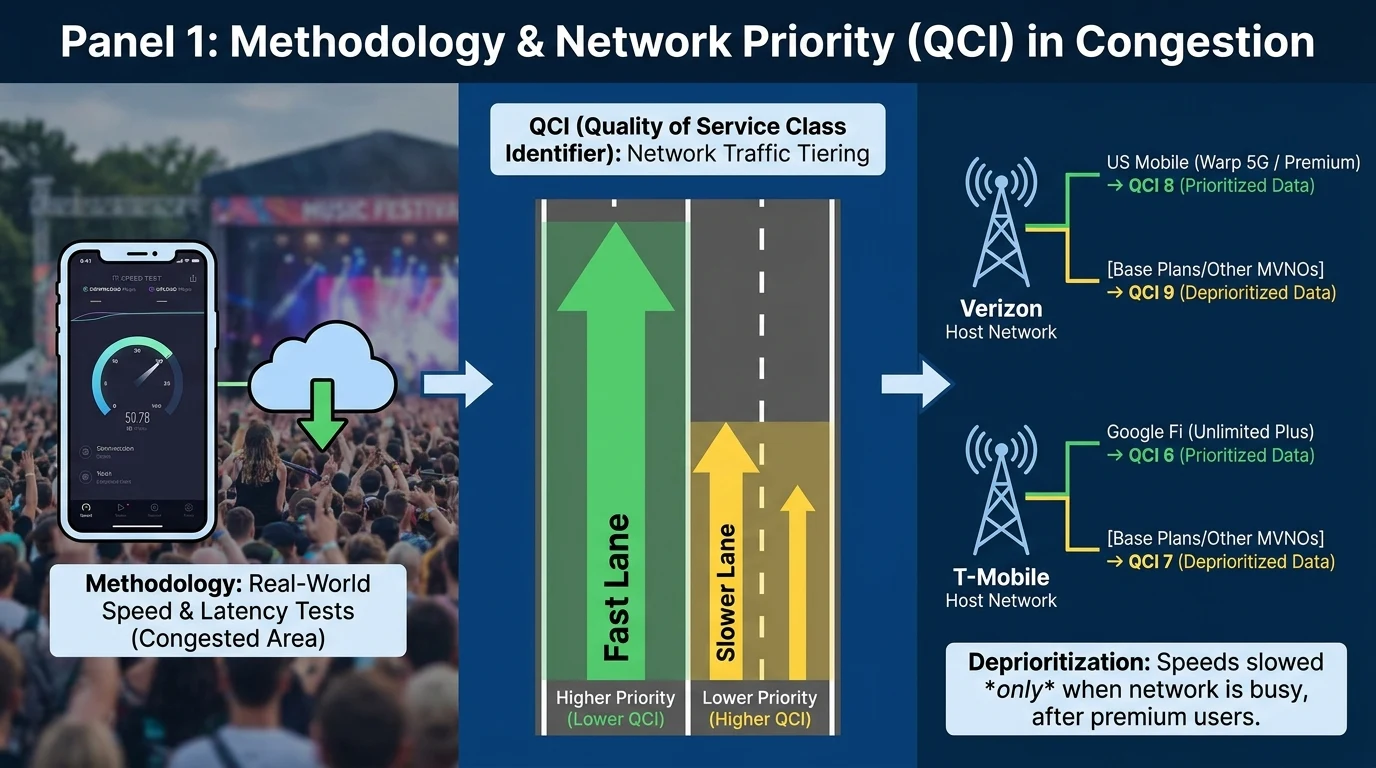
QCI, or Quality of Class Indicator, is a standard that assigns priority levels to data traffic on mobile networks. Lower QCI numbers indicate higher priority, which typically means better performance during congestion. However, neither US Mobile nor Google Fi publicly disclose their specific QCI assignments, which are crucial for understanding how these plans perform under load.
For more on QCI levels and their impact, see our detailed guide on MVNO QCI Levels and Data Deprioritization Explained.
Deprioritization in Practice
Deprioritization occurs when network traffic exceeds a certain threshold, causing lower-priority data to slow down during congestion. US Mobile's Warp 5G plan offers 100GB of priority data, while Google Fi's Unlimited Plus plan provides 50GB. After these limits, both plans experience reduced speeds, especially in high-traffic areas.
Real-World Speed Testing Methodology
Testing Setup
To compare these plans, we conducted speed tests using the Ookla Speedtest app at various times and locations, focusing on peak congestion periods (7-9 PM local time). Tests were performed on both 4G and 5G networks to measure download/upload speeds, latency, and jitter.
Results
| Network/Plan | Typical Speed Range | Average Download Time (102 MB) |
|---|---|---|
| US Mobile Warp (Verizon) | 30–702 Mbps | 3:43 minutes |
| US Mobile Light Speed (T-Mobile) | 79–357 Mbps | 1:00 minute |
| Google Fi Unlimited Plus (T-Mobile) | 600–700 Mbps | Consistent performance |
US Mobile's Light Speed on T-Mobile delivered the fastest average speeds, while Warp on Verizon showed the most variability. Google Fi maintained consistent speeds, benefiting from T-Mobile's mid-band 5G.
Interpreting the Results
T-Mobile vs. Verizon
T-Mobile's mid-band 5G offers better indoor penetration and consistent speeds, making it ideal for urban environments. Verizon's high-band 5G provides higher peak speeds but suffers from limited coverage and poor indoor performance.
For more insights on T-Mobile's network performance, check out our comparison of Mint Mobile vs. Google Fi After 22GB.
Practical Implications
Both US Mobile and Google Fi face deprioritization, but the impact varies by location and network load. US Mobile's Warp plan may offer better performance in rural areas due to Verizon's network, while Google Fi excels in international coverage.
FAQ
What happens when I exceed my data limit?
- US Mobile: After 100GB, data is deprioritized during congestion.
- Google Fi: After 50GB, speeds are throttled to 256kbps.
How can I check my QCI level?
QCI levels are not typically disclosed by carriers. You may need to contact customer support for detailed information.
Disclaimer
This article is based on independent testing and available carrier information as of October 2023. Network performance can vary based on location, device, and other factors. Always verify plan details on the official carrier websites.
Visual summary